How to Clean a Cassette Tape That Has Been in Storage
The box has been in the garage for twenty years and the tapes do not look the way you remember. Here is what can be cleaned at home, and how.
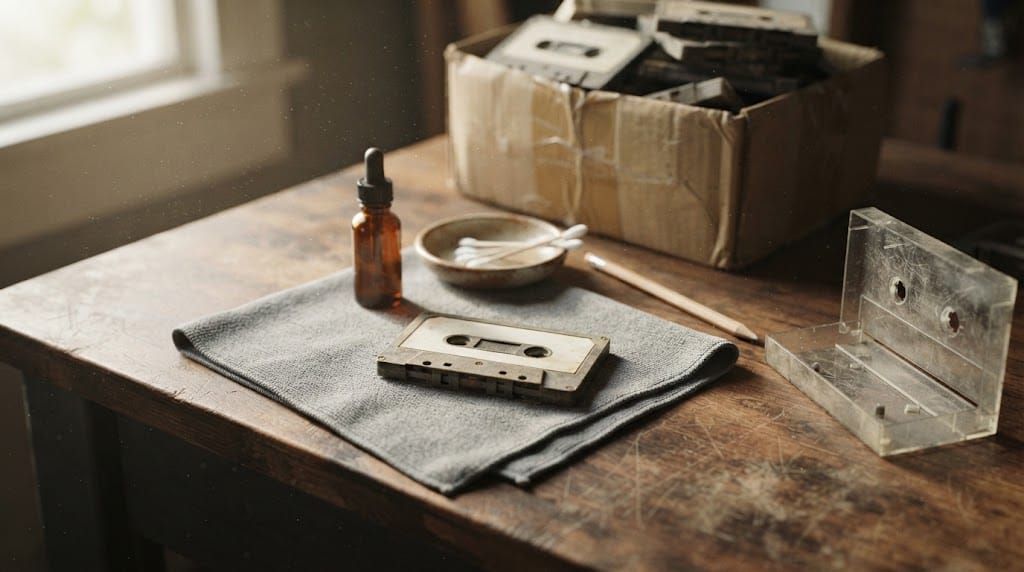
The box has been in the garage for twenty years. When you finally open it, the tapes are all there, but they do not look the way you remember. The cases are cloudy. There is a film of dust in the corners, a faint smell of damp, and on one or two of them something pale along the edge of the tape that you would rather not think about.
Most of what you are looking at can be cleaned at home in an afternoon. Some of it should not be touched without care. The first job is telling the two apart.
Look before you play
Do not put a stored tape straight into a player. Hold it up to the light and check three things.
First, the shell. Dust and grime on the outside are harmless and easy to remove. Second, the tape itself, through the window and at the open edge. It should be dark, smooth and evenly wound. White, grey or greenish specks, or a powdery bloom on the tape, are mold. Third, the small felt pad behind the tape in the center opening. If it is missing or hanging loose, the tape will play badly until it is fixed.
Sort the box into three piles: dusty, moldy and damaged. Keep the moldy ones away from the rest, because mold spreads from tape to player to every tape played afterwards.
Cleaning a dusty tape
This is the simple case. Take the cassette out of its case and remove the paper insert. Wash the empty plastic case in warm soapy water, rinse it and let it dry completely.
Wipe the cassette shell with a dry microfiber cloth. For marks that will not lift, dampen a corner of the cloth with a little isopropyl alcohol and work around the label, not over it. Use a dry cotton swab to lift dust from the openings along the bottom edge. Never use water or household cleaners near the tape, and do not touch the tape surface with your fingers.
Then wind it. Fast-forward the tape to the end and rewind it fully, once. This loosens layers that have been pressed together for years and shakes off loose dust. It is worth keeping an inexpensive portable cassette player for this, so that old tapes get their first run somewhere other than your best machine.
Cleaning a moldy tape
Mold is the serious one, and it deserves honesty. A tape with heavy growth, or one that holds a recording you cannot replace, is a job for a professional transfer service. They clean and digitize it in one pass, with the right equipment.
For light mold on a tape you are willing to risk, work outdoors or by an open window, and wear gloves and a mask. Fold a lint-free cloth, moisten it lightly with isopropyl alcohol of 90 percent or more, and hold it gently against the tape at the open edge while you wind slowly from one end to the other, either by hand with a pencil in the reel or in a player you do not mind sacrificing. Refold the cloth to a clean patch as it picks up residue. Let the tape air for a few minutes before winding it back.
Afterwards, clean whatever player you used. A cotton swab and a little isopropyl alcohol on the heads and the metal guide posts will do it. Then play the tape once and copy it, because a tape that has had mold may not survive a second cleaning.
When the tape is damaged
A missing pressure pad can be glued back or replaced with one from a tape you do not need. If the shell is held together with small screws, it can be opened and the reels moved into a clean shell from a donor cassette. If the tape squeals, sticks or stops, do not force it. Stop, and decide how much the recording matters before going further.
For anything precious, the safest route is to get one good playback and copy it, either to a file or onto a fresh blank cassette.
Keeping them clean
Cleaning is only worth doing once. After that, the tapes need to live somewhere better than the garage: upright, in their cases, cool, dry and away from sunlight and speakers. A proper cassette storage case keeps dust out and makes it easier to find what you want, and there is a full guide to how to store and protect a cassette tape collection.
Once they are clean, they need something to play on. If the old deck did not survive storage either, here are the portable cassette players worth buying now.
Some of the tapes in that box will be albums. One or two will be something else: a tape someone recorded for you, song by song. Those are the ones worth all this trouble. And if cleaning them makes you want to give someone the same thing, that is easy to do.
When you're ready, start creating your own mixtape.