How to Store and Protect Your Cassette Tape Collection
Cassettes can last for decades — if you treat them right. Here's everything you need to know about storing and protecting a cassette collection, from temperature control to magnetic fields to the right case.
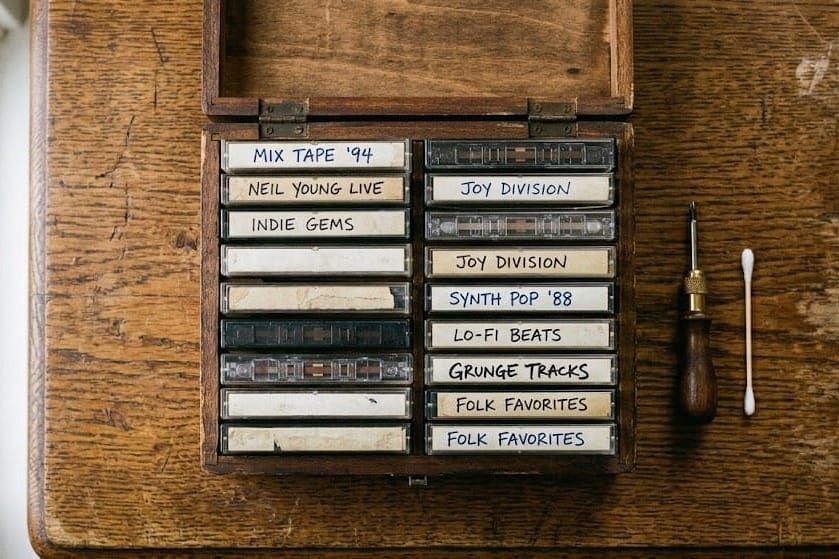
There's a particular kind of satisfaction in owning a cassette collection. The weight of the cases in your hands, the handwritten labels, the way a tape from 1989 can still hold an entire world inside it if you treat it right. But that "if" matters. Cassettes are resilient in ways people don't expect — and fragile in ways that can quietly ruin everything.
If you've been building a collection, or you've just inherited one, or you recently started buying tapes again because something about them makes the music feel more real, this guide is for you. Here's how to actually take care of what you have.
Why cassette storage matters more than you think
The magnetic tape inside a cassette is sensitive. It doesn't announce when it's deteriorating. You won't notice anything wrong until you press play and the sound is warped, muffled, or gone entirely. Heat, humidity, dust, and magnetic fields are the main enemies — and most people unknowingly expose their tapes to at least one of them on a regular basis.
The good news is that proper storage is simple once you understand what you're working against. And the tapes that survive with care can last for decades.
The right environment
Temperature and humidity are the two variables that matter most. Cassettes do best in cool, dry conditions — ideally somewhere between 60°F and 70°F (15°C to 21°C), with relative humidity around 40–60%. Anything above that and you risk the tape layers sticking together, which is every collector's nightmare.
Avoid storing tapes in places that fluctuate. Attics heat up in summer. Basements get damp. Car glove compartments are brutal — the heat inside a parked car can reach temperatures that will warp both the tape and its plastic housing. Garages are similarly problematic unless they're climate-controlled.
A bedroom bookshelf or a dedicated interior storage unit is usually the safest bet. Consistent and moderate wins every time.
Keep them away from magnets
This sounds obvious, but magnetic fields can degrade or erase tape without any visible sign of damage. The problem is that magnets are everywhere: speakers, subwoofers, older televisions, certain electronic devices. Even some bags and cases use magnetic clasps.
Store your cassettes away from audio equipment when possible. Don't stack them directly on top of a speaker cabinet or next to a power amplifier. If you're storing a larger collection, a wooden shelving unit away from your stereo setup is a better choice than anything built into or sitting beside your hi-fi system.
Always store tapes on their side, rewound
This one divides collectors, but the general consensus among archivists and tape enthusiasts is to store cassettes standing upright on their spine — not flat — with the tape fully rewound to Side A. Storing flat puts pressure on the reels in a way that can cause the tape to deform over time.
Rewinding before storage matters because tape that sits wound to the middle for months or years can develop uneven tension. When you play it back, you'll hear flutter or pitch irregularities. It only takes a few seconds to rewind fully before you put a tape away, and it's worth building the habit.
The case question
Most cassettes came in a standard plastic case, and if yours still have them, keep them in them. The case isn't just aesthetic — it keeps dust off the tape heads and protects the reels from impact damage if a tape gets knocked off a shelf.
For tapes that have lost their cases, there are replacement shells available, and universal cassette cases that hold multiple tapes. If you're building a more serious collection, purpose-made cassette storage boxes offer individual slots that hold each tape upright and protected.
This is where the cassette storage case on Amazon is worth looking at. It's one of the cleaner solutions for anyone with a growing collection who doesn't want tapes scattered across a shelf — structured, stackable, and built specifically for the format.
Cleaning and maintenance
Even stored cassettes benefit from occasional care. Dust accumulates on the tape heads of your player, which affects playback quality, but the tapes themselves can also collect debris inside the shell. If a tape sounds slightly off — slightly dull, or with occasional dropout — before assuming it's damaged, try cleaning the heads of your player with isopropyl alcohol and a cotton swab.
For tapes that have been sitting in storage for a long time, it's worth "exercising" them before playing: fast-forward to the end and rewind back before you press play for the first time. This helps redistribute the tension across the reels and reduces the risk of the tape snapping or getting tangled on the first play.
What about tapes that seem damaged?
Shells crack. Reels jam. Tape occasionally gets tangled. None of these mean a tape is necessarily beyond saving. Cassette repair is a real skill, and the basic version of it — opening a shell, re-spooling a tangled tape, replacing a cracked housing — is manageable with a screwdriver and patience. Replacement shells are cheap and widely available, and there are good guides online for the most common repairs.
The more serious version of tape damage — mold, shed, or sticky shed syndrome in high-humidity cases — is harder to fix but still not always fatal. If you encounter a tape that smells musty or sounds severely degraded, there are archival baking techniques that can sometimes recover the audio. These are well-documented by audio archivists and worth researching before you give up on a tape with sentimental value.
Building a collection worth keeping
Part of the pleasure of cassettes is their physicality — the weight, the click of the case, the tactile experience of putting on a tape before you listen. That same physicality means they need a bit more intention than a Spotify library. But that's not a downside. It's part of what makes them feel real.
If you've been thinking about why physical music hits different, the answer is partly this: ownership. A cassette you've cared for, kept in good condition, and returned to over years is a different kind of object than a file. It has a history. It has a relationship to the moments you played it. And a well-stored collection preserves all of that.
For people rediscovering the format — or anyone caught up in the lo-fi revival and what it actually means — the cassette's imperfection is part of the appeal. The slight warmth, the gentle hiss, the sense that the music lives on something tangible. That feeling survives as long as the tape does.
A note on custom cassettes
There's one more thing worth mentioning, especially if you collect tapes because they feel personal. Custom cassettes — tapes recorded with your own tracklist, your own artwork, your own message on the label — sit at the intersection of music and memory in a way that even the rarest original pressing can't quite replicate. They're made for someone specific. They exist because of a relationship, a moment, a feeling that needed a physical form.
If you've been thinking about creating one — whether as a gift or simply as a record of something you want to keep — Customixtape makes them properly: pressed, labeled, and cased in the same format your collection already uses. Something worth adding to a shelf that's built to last.
Take care of your tapes. They'll take care of the music.