What Does a Custom Cassette Tape Actually Look Like?
You like the idea of a custom cassette, but you want to picture it before you give one. Here's what you'd actually be placing in someone's hands.
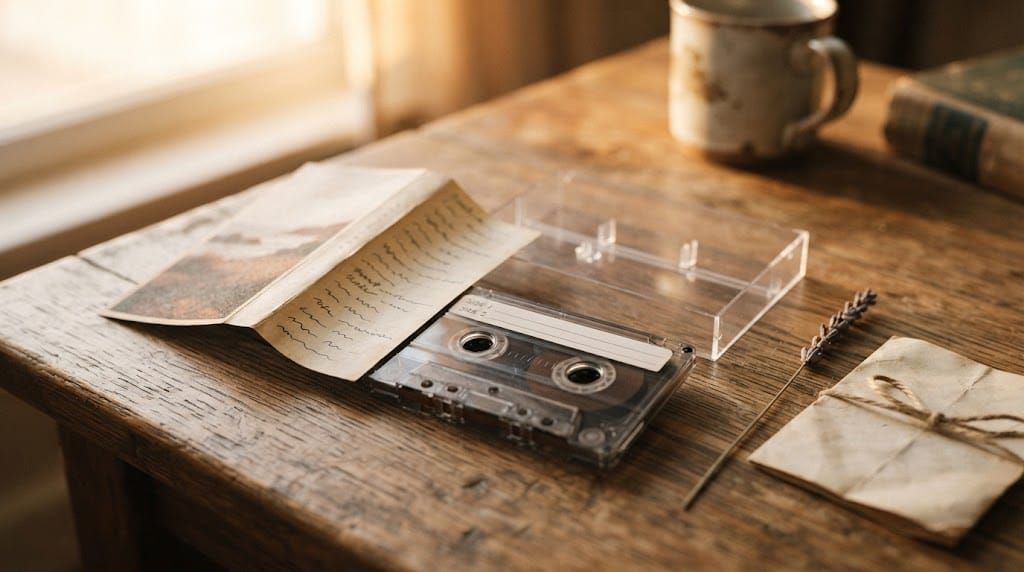
Maybe you have seen the words "custom cassette" in a gift guide and something in you softened a little. Then the practical question arrived right behind the feeling. What would you actually be handing someone? A plain blank tape with a sticker on it? Something that looks retro in photos but feels cheap once it is out of the box?
It is a fair thing to wonder, especially if the last cassette you held was in a car glovebox twenty years ago, or if you have never owned one at all. So let's take one apart gently, piece by piece, the way the person receiving it will.
The case you hold first
Before anything else, there is the case. Most custom cassettes arrive in the classic clear plastic box, the kind that clicks open with a small, satisfying snap. It is lighter than people expect and smaller too, roughly the size of a deck of cards laid flat. That size is part of the charm. It fits in a coat pocket, a drawer, the side of a bag, which is exactly why so many old tapes ended up travelling with people for years.
Through the clear front you see the cover art before you see anything else. That first glance works a bit like the front of a letter. It tells the person this was made for them before a single song has played.
The J-card, where the story lives
The printed insert folded inside the case is called a J-card, named for the shape it makes when you look at it from the side. This is where a custom cassette really becomes custom.
The front panel usually carries the cover image. It might be a photo of the two of you, a picture from a trip, a simple color with a title, or a design that feels like the person it is for. The narrow spine carries the title, the part you read when the tape is standing on a shelf next to others. Unfold the flap and you find the tracklist, and often a short message, a date, or a line that only the two of you will understand.
This is the part most people spend the longest time on, and it is worth it. A playlist link gives someone a list of songs. A J-card gives them a small printed object that says who it is from, when it was made, and why. We wrote more about that difference in why a cassette gift feels more personal than a playlist link, because it is usually the moment people understand what they are really giving.
The shell and the labels
Take the tape out of the case and you are holding the shell, the plastic body that houses the reels. Shells come in more variety than most people remember. Clear shells let you see the tape winding from one side to the other, which has a quiet, almost hypnotic quality when it plays. Colored or tinted shells feel more playful. Solid black or white shells look cleaner and a little more classic.
On the shell itself sit the labels, one for Side A and one for Side B. On a custom tape these often echo the cover design or carry the title again, so the tape still makes sense even if it gets separated from its case, which, with cassettes, it eventually will.
That idea of two sides matters more than it seems. A cassette asks you to think in halves. Side A might open with the songs from when you first met, and Side B might carry the ones from now. It is a small structural detail, but it shapes how a mix feels when someone listens to it from start to finish.
What it feels like when it plays
A photo can show you what a custom cassette looks like, but not what it is like to use one. You press it into a player, close the door, and hear the faint mechanical sound of the tape catching before the music starts. There is a little texture in the sound, a warmth and a light hiss that digital files have polished away. If you have ever wondered why people are drawn back to that, the appeal of tape hiss in a flawless digital world is a story in itself.
You also cannot skip around easily. Fast-forwarding is a guess, rewinding takes time, so most people end up listening the way the mix was meant to be heard, in order. For a gift, that is a quiet advantage. The person hears the songs in the sequence you chose, the transitions you thought about, the ending you saved for last.
Cassette or CD?
Some people picture a cassette and realise halfway through that what they really want is a CD, with its shinier finish, printed disc, and easier playback. Others feel the pull of the tape immediately and would not want anything else. Both are physical, both can be designed from cover to tracklist, and both end up on a shelf rather than lost in an app. If you are weighing the two, our guide to choosing between a custom cassette and a custom CD walks through the differences in look, sound, and practicality.
Why the look matters as much as the music
It would be easy to say that only the songs count and the packaging is decoration. But anyone who has kept an old mixtape knows that is not quite true. The handwriting on the label, the faded cover, the scribbled note inside the flap are the things that bring the memory back years later, sometimes before the music does.
A custom cassette is designed to become that kind of object. It is small enough to keep, specific enough that it could only belong to one person, and physical enough that it does not disappear when a subscription ends or a phone gets replaced. That is really the heart of what makes a mixtape still matter as a gift. The songs say what you feel. The object proves you took the time to say it properly.
So when you picture a custom cassette now, picture something simple and unmistakably personal. A clear case with a cover that means something. A spine with a title only the two of you would choose. Two sides of music arranged with care. And somewhere on the inside flap, a few words that turn the whole thing into a letter you can play.
When you're ready, start creating your own mixtape.