The Songs That Saved You: How to Turn a Rough Year Into a Gift
Most of us have one year that asked more than it gave, and the songs that carried us through it. Here's how to turn them into something worth giving.
Most of us have one. A year that asked more than it gave. Maybe it was a loss, a move, a breakup, a job that fell apart, or just a long stretch when everything felt heavier than it should. And almost always, somewhere in that year, there were songs. The ones you played on repeat on the bus home. The one you couldn't listen to for months afterward. The one that came on at exactly the right moment and made you feel a little less alone.
Those songs rarely get talked about. But they hold something real, and there is a quiet, meaningful way to honor them: turning them into a gift.
Why hard-time songs stay with us
Music we hear during difficult periods tends to stick harder than anything else. When life is steady, a song is just a song. When life is shaking, a song can become something to hold on to, a few minutes of order and feeling when everything else is out of place.
That's part of why some tracks can still send you straight back to a specific kitchen, a specific winter, a specific version of yourself. We explored that connection in why some songs instantly take you back to a moment, and hard years tend to create the strongest of those links. It is also why you might have found yourself playing the same songs again and again during that time. Repetition is a kind of comfort. The song knew what was coming, even when you didn't.
Who the gift is really for
A healing playlist gift can take a few different shapes, and it helps to know which one you are making before you begin.
Sometimes it is for the person who stood beside you. The friend who answered the phone at two in the morning, the sibling who drove across the country, the partner who stayed patient when you weren't easy to be around. A mixtape made from the songs of that year becomes a way of saying thank you for something that is almost impossible to say directly. They were part of the soundtrack, even if they never knew which songs you were playing.
Sometimes it is for someone going through their own rough year right now. In that case, the mix becomes less of a memory and more of a hand on the shoulder: these songs helped me, maybe they'll help you too. It says you understand without making it about you.
And sometimes, honestly, it is for yourself. A physical record of a chapter you survived, something to keep on a shelf as proof that the hard part ended.
Choosing the songs honestly
The instinct is often to pick only the uplifting tracks, the ones that sound like recovery. But a mix that feels true usually includes a little of the darkness too. The song that matched the lowest point. The one that made you cry in the car. The one that first made you feel like things might be okay again.
Try thinking of the year in chapters rather than moods. What were you listening to when it started? What carried you through the middle? What was playing when the light started coming back? Following that path gives the mix a natural shape, and it lets the listener feel the movement of the year rather than just its hardest moments.
Be gentle with yourself as you go. Some songs may still be too raw to include, and that is okay. A healing mix doesn't need to hold everything. It only needs to hold enough.
Let the order tell the story
Sequence matters more here than in almost any other kind of mixtape. Starting heavy and ending hopeful is the most natural arc, and it works because it mirrors what the listener wants to believe: that difficult things pass.
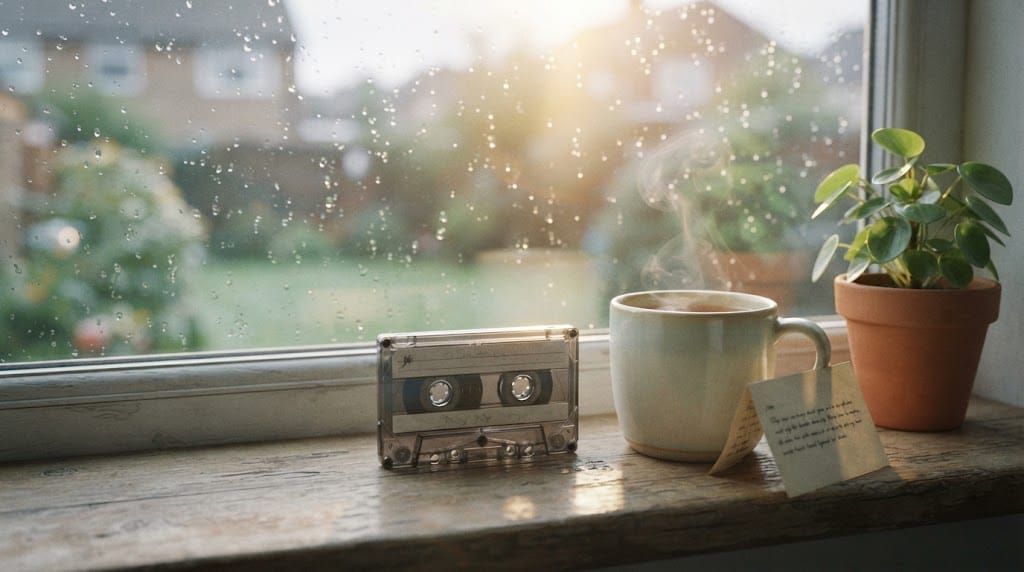
If you are making a cassette, the two sides can carry that idea beautifully. Side A for the rough months, Side B for the way back. On a CD, you might end with a song that feels like opening a window, something with space and air in it, so the last thing they hear leaves them lighter than when they began.
Say just enough in the note
The note that comes with a healing mix can be the hardest thing to write. You might want to explain everything, or nothing at all. Usually the right answer is somewhere in between.
A few words can carry a lot. "These are the songs that got me through last year. You were in all of them." Or for someone going through their own storm: "This helped me. I hope some of it helps you." You don't need to name what happened. The person who receives it will understand, and the songs will fill in the rest.
Why it should be something you can hold
A healing playlist on a streaming app can disappear into a menu, reshuffled, forgotten, or lost when a subscription lapses. A CD or cassette is different. It has weight. It sits somewhere in the home, and every time the person sees it, it reminds them of something real: that they were thought of, that someone remembered, that a hard time became a shared story.
There is a reason physical music hits different, and it matters most with gifts like this one. A tangible object says the feeling was important enough to be made into something permanent. It turns a difficult chapter into a keepsake instead of a wound.
What the music gives back
Turning a rough year into a gift doesn't erase what happened. But it changes the relationship to it. The songs stop being only reminders of pain and start becoming evidence of resilience, of connection, of the people and melodies that held you up when you needed it.
And when you give that to someone else, you give them a small piece of your story. Not the polished version, the real one. That kind of honesty is rare, and it is often remembered long after the year itself has faded.
When you're ready, start creating your own mixtape.