What Makes a Good Mixtape: The Unwritten Rules
There's a moment, usually between the third and fourth song, when you know. Either the mixtape is working — or it isn't.
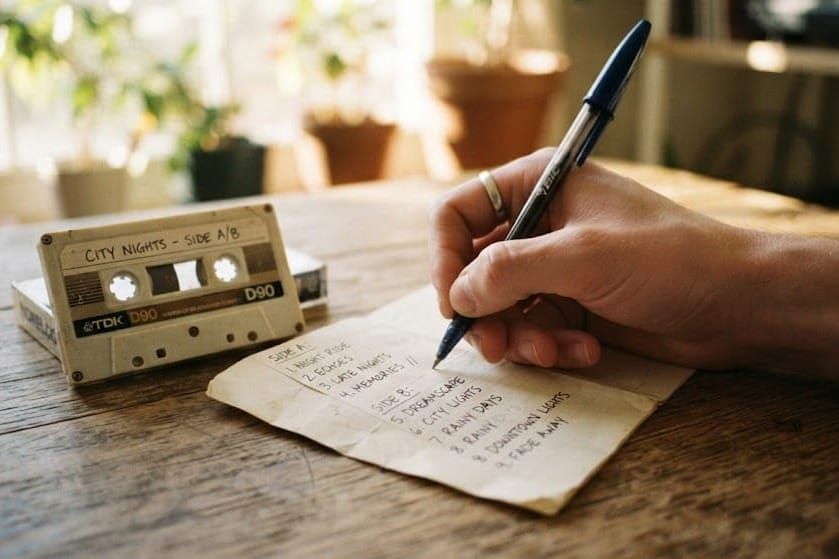
There's a moment, usually somewhere between the third and fourth song, when you know. Either the mixtape is working — or it isn't. You can feel it the way you feel a conversation that's going somewhere real versus one that's just filling silence. Good mixtapes don't announce themselves. They pull you in quietly and keep you there.
But what actually makes a mixtape good? Not just fun, not just a collection of songs you like, but genuinely, memorably good? Nobody wrote it down. Nobody had to. The people who made great mixtapes in the eighties and nineties figured it out by feel, by trial and error, by listening back to what they'd made and sensing when something was off. The rules were always there. They just lived in the gut, not on paper.
Here are a few of them.
The first song sets a promise. It doesn't have to be the most important song, but it has to be honest. Whatever feeling it opens with — warm, melancholic, restless, joyful — the rest of the mixtape will be judged against that promise. A jarring opener that doesn't connect to anything that follows is the fastest way to lose someone. The first song is an invitation. It should feel like one.
Order is everything. A great mixtape isn't just a great list of songs — it's a great sequence. There's a rhythm to how tracks should rise and fall, when to push and when to hold back. Think of it less like a playlist and more like a journey with a shape. Some of the most well-crafted mixtapes on record have songs that, taken individually, aren't even the maker's favorites. But placed exactly where they are, they make everything around them better. Sequencing is where taste becomes craft.
Contrast is the secret ingredient. This is the one people most often get wrong. A mixtape made entirely of the songs you love most tends to flatten out. Emotionally, it has nowhere to go. The quieter songs give meaning to the louder ones. The slower moment makes the next uplift feel earned. A little tension, a small surprise somewhere in the middle, something unexpected — that's what keeps a listener present instead of just passively hearing music in the background.
It's not about showing off. There's a version of a mixtape that's really just a showcase of the maker's taste. Look at what I've discovered. Look at how eclectic I am. That kind of mixtape can be interesting, but it rarely feels like a gift. The best ones are built around the listener. What does this person need to hear right now? What song would make them feel exactly the right thing at exactly the right moment? That shift — from "here's what I love" to "here's what I made for you" — is what turns a mixtape into something lasting. You can read more about that shift in how to build a romantic mixtape, where the emotional logic behind song selection runs even deeper.
The last song carries everything. It's the note you leave the listener on. It doesn't need to be the biggest or the most obvious choice — in fact, quiet endings often hit harder than dramatic ones. But it needs to feel final in the right way. Like a conversation that closes well. Like something you want to sit with for a minute before you press play again.
Every song is a decision. This is maybe the most fundamental rule of all. On a streaming playlist, it costs nothing to add a track. You drag it in and move on. On a mixtape — whether it's a cassette you recorded song by song or a custom CD you put together with care — every inclusion is a small act of intention. You chose this. You thought about it. That weight is exactly what makes a physical mixtape feel different from an algorithm's suggestion. The person who made it considered you.
That consideration is what people remember. Not the tracklist. Not even the specific songs, always. But the feeling that someone paid attention, that someone took the time, that someone made something with them in mind.
It's a rare thing. And it doesn't really go out of style.
When you're ready, start creating your own mixtape.