How to Pick the Right Song Order for a Mixtape Gift
A mixtape isn't a collection — it's a sequence. Here's how to think about song order so the whole thing feels like it was going somewhere from the start.
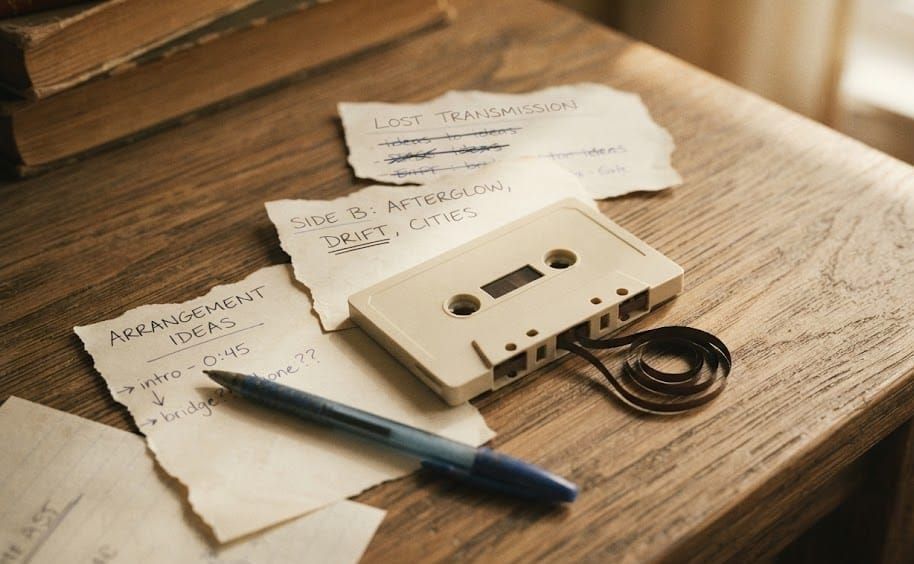
Picking the songs is only half of it. Maybe less than half.
A mixtape isn't a collection — it's a sequence. The same twelve songs can feel completely different depending on the order you put them in. They can build toward something or collapse into each other. They can create an emotional arc that lands with real force, or they can just feel like a shuffle. The difference between a great mixtape and a forgettable one is almost never the individual tracks. It's almost always the order.
If you're making a mixtape as a gift, here's how to think about the sequence.
Start with the shape, not the first song
Before you decide what to open with, figure out what the mixtape is actually trying to do. Is it a love letter? A portrait of a friendship? A gift for someone going through something hard? A collection of songs that defined a particular stretch of time you shared together?
The shape of the mixtape — its emotional arc — determines everything else. Most memorable mixtapes follow something like a three-act structure: an opening that draws the listener in, a middle that moves through different emotional territory, and a closing that leaves them somewhere specific. You don't have to be rigid about this, but having a rough sense of the journey helps you make decisions about individual songs that would otherwise feel arbitrary.
Think of it less like curating and more like editing a film. You're not just choosing what's in it — you're choosing what it does.
The opener sets the tone for everything
The first song is a promise. It tells the listener what kind of emotional space they're about to enter, and it creates an expectation that the rest of the mixtape either fulfills or deliberately subverts. Get it wrong and the whole thing can feel slightly off, even if every subsequent song is exactly right.
A common mistake is opening with the best song. It's understandable — you're excited about it, you want to lead with impact — but it often doesn't work. The best song on the mixtape usually belongs somewhere in the second half, once the listener is already in the right frame of mind to receive it.
A better opening is a song that invites. Something that signals what's coming without overwhelming on the first beat. Something that makes the person press play again before the first track is even over.
The middle is where most mixtapes fall apart
The opening and closing of a mixtape tend to get the most thought. The middle gets neglected. And the middle is where people actually live with the thing — it's the longest stretch, and if it loses momentum, it loses the listener.
The middle needs to do one of two things: deepen the mood established at the start, or shift it. A mixtape that stays in exactly the same emotional register for thirty minutes starts to feel airless. Even within a consistent theme — love, grief, joy, nostalgia — there's room for variation in tempo, texture, and intensity. Those shifts are what keep the listener present.
A useful technique is to think in pairs. Two songs that feel like they belong together can be placed back-to-back intentionally, so the transition between them becomes part of the experience. A fast song followed by a slow one can feel like exhaling. A melancholy song followed by something more hopeful can feel like turning a corner. These small movements, repeated across the middle section, are what give a mixtape its sense of narrative.
Transitions are their own art
The gap between songs — or the absence of a gap — shapes how each one lands. When a track ends in a way that flows naturally into the next one's opening, the two songs start to feel like a single, longer piece. When there's a deliberate tonal shift, the new song hits with more force precisely because something just ended.
Pay attention to key and tempo when placing songs next to each other. You don't need to be a music theorist about it, but jarring transitions — a quiet, intimate track followed immediately by something that crashes in at full volume — can knock the listener out of the emotional space you've built. Sometimes that's exactly what you want. Usually, it isn't.
End somewhere true
The closing song is a statement. It's the last thing the person hears, the note they carry with them after the tape stops, and it's what they'll associate with the mixtape when they think back on it months or years later.
The closer doesn't have to be the most emotional song on the tracklist. But it has to feel like an ending — like the mixtape arrived somewhere it was always heading. A good closing song leaves space. It doesn't explain itself. It just settles, and then it's quiet, and the listener sits with it.
One useful question: what do you want the person to feel thirty seconds after the last song ends? Work backward from that feeling, and you'll usually find the song.
Let it rest, then listen through
Once you've arranged the order, step away for a day if you can. Come back and listen to it the way the other person will — from the beginning, without skipping, without pausing to second-guess. You'll feel almost immediately if something is wrong, and you'll usually know exactly what to move.
The insert and the title matter too, but they can only reinforce what the sequence has already built. Get the order right, and the rest of the mixtape writes itself.
When you're ready to commit it to tape or disc, start creating your own mixtape — and trust the order you've worked out.