How to Make a Music Gift Feel More Personal With Handwritten Notes
A custom mixtape already carries meaning. A handwritten note makes it irreversible. Here's how to add the words that turn a music gift into something someone keeps forever.
There is a version of gift-giving that feels complete the moment you hand something over, and another version that lingers — that the person comes back to, reads again, keeps in a drawer somewhere. The difference, more often than not, is a few lines written by hand.
A custom mixtape or CD already carries a lot of meaning on its own. The song selection, the sequence, the physical format itself — all of it communicates care in a way that a digital playlist never quite can. But a handwritten note changes the register entirely. It shifts the gift from something curated to something declared. And that shift matters more than most people realize.
Why Handwriting Does Something That Typing Cannot
We live in an era of frictionless communication. Messages are instant, editable, deletable. Nothing leaves a permanent mark unless you choose to make it so. That is exactly why handwriting carries such weight now — because it is irreversible. You cannot unsend a handwritten note. Every crossed-out word, every uneven line, every ink smudge is evidence that a real person sat down and tried to say something.
There is research behind this, but you do not need research to feel it. Think about the last time someone gave you something with a handwritten message versus a printed card. The handwritten one is probably still somewhere. The printed one, almost certainly, is not.
What to Actually Write (And What to Avoid)
The instinct, when sitting down to write a note for a music gift, is to explain. To justify the song choices, to list what each track represents, to turn the note into a kind of liner note essay. Resist this. The songs can speak for themselves — that is the whole point of choosing them carefully.
What a handwritten note does best is say the thing the music is already gesturing toward, but in your own voice. Not "Track 4 is the one we danced to in your kitchen" — the recipient will remember that without being told. Something closer to: "I keep thinking about that night. I wanted you to have it somewhere permanent."
Short is almost always better. Two or three sentences that feel true will outlast two paragraphs that feel thorough. The goal is not completeness. The goal is presence — the sense that you were thinking specifically about this person when you wrote it.
The Track List as an Invitation
One of the most underrated elements of a physical music gift is the track list. As we explored in our piece on why physical mixtapes outshine digital links, the act of holding something — touching the paper, reading the titles before pressing play — creates a different kind of anticipation than scrolling a screen.
A handwritten track list amplifies this further. You do not need to annotate every song, but a small note beside one or two tracks can be remarkably powerful. A parenthetical. A date. A single word that only the two of you would understand. These small markings turn a playlist into a map — one that only one person in the world can fully read.
The Packaging Is Part of the Message
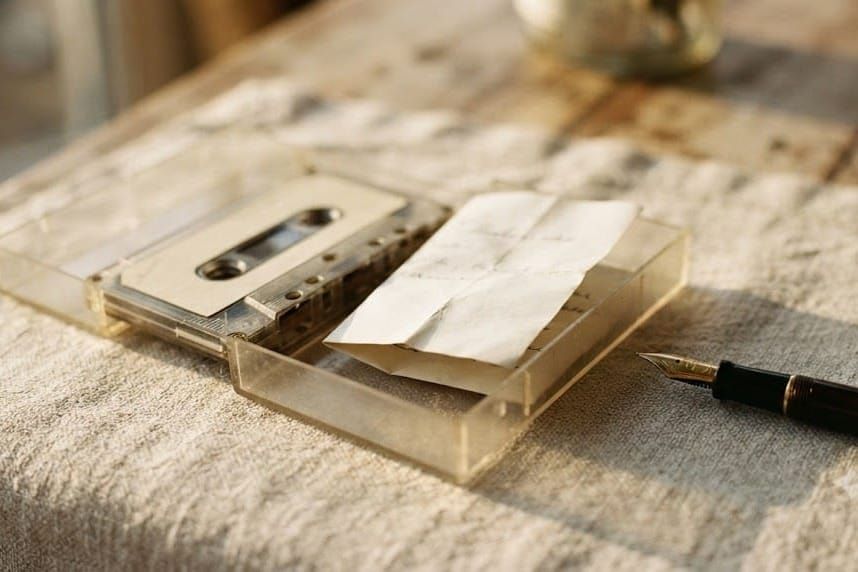
How a note is presented matters almost as much as what it says. A folded piece of paper tucked inside the cassette case or slipped into a CD sleeve feels like finding something — like the note was waiting there for you. This is very different from a card attached to the outside of a gift, which signals "this came with a note" before the recipient has even opened anything.
If you are giving a custom mixtape, consider writing on the inner sleeve insert, on the back of the track list, or on a small card folded and placed inside the case. The moment of discovery — opening the case and finding your handwriting there — is a small emotional event that a perfectly wrapped external card can never replicate.
When You Are Not Sure What to Say
Sometimes the hardest part is not the writing — it is the starting. The blank paper feels larger than whatever feeling prompted the gift in the first place.
A useful approach: write the note before you finalize the track list, not after. When you are still in the process of choosing songs, the emotional logic of the gift is clearest. What are you trying to say? Who are you thinking about? Write that down, even roughly, before it becomes abstract. The final note does not have to look anything like the draft — but having the draft means you will not be staring at a blank page when the gift is already wrapped and the moment is already here.
And if the note ends up being two sentences and a signature, that is enough. Enough honesty, in the right handwriting, at the right moment, is more than enough.
If you are putting together a music gift and want a foundation worth writing about, start creating your own mixtape — and let the handwritten note do the rest.