Best Walkman Cassette Players in 2026
Cassette players got better, not just more nostalgic. Here are five Walkman-style picks for 2026, and why what's on the tape matters more than the player itself.
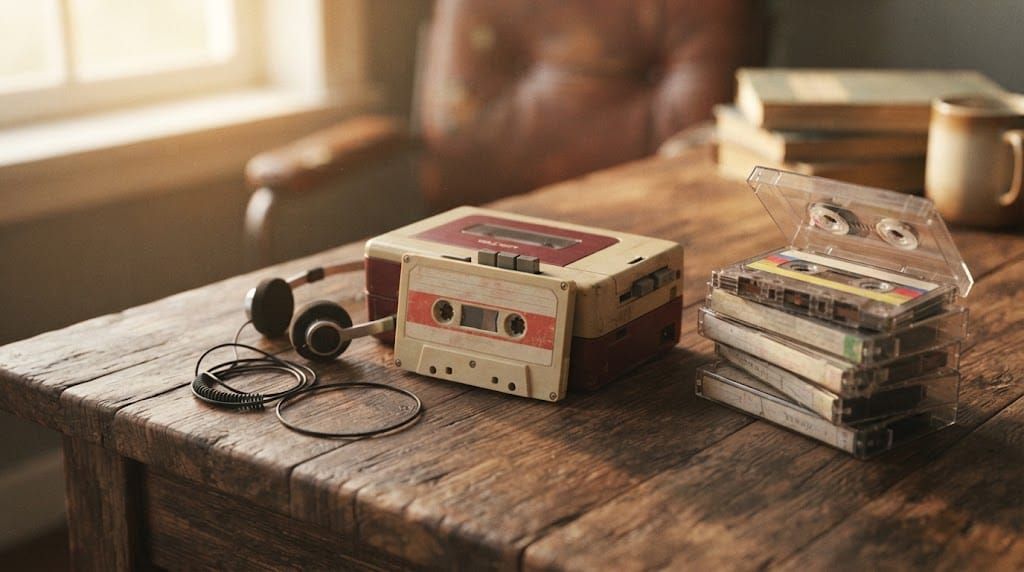
There's a particular sound a cassette makes when it clicks into place — a small mechanical certainty that a phone screen just doesn't have. That sound is a big part of why Walkman-style players never fully disappeared, and why 2026 is actually a decent year to buy one. The category has quietly matured: better auto-reverse mechanisms, real rechargeable batteries instead of a graveyard of AAs, and in some cases Bluetooth bolted onto a format that predates it by four decades.
The players below cover a real range, because "best Walkman" means different things depending on what you're actually trying to do — listen on the move, dig out old mixtapes, or just own something that feels like a small piece of design history.
If you want something that looks and feels like the real thing but plays nicely with modern gear, the TOMASHI Walkman-style cassette player is the strongest pick here. It's got a belt clip, a headphone jack for the purists, and a Bluetooth transmitter for everyone else — so the same cassette can go straight to wired headphones or stream to a pair of wireless ones without anyone having to choose sides. USB-C charging means it's not competing with your phone for a proprietary cable, which matters more than it sounds like it should when you're trying to actually use something daily instead of just displaying it.
For anyone sitting on a shoebox of unlabeled tapes from a decade ago, an auto-reverse cassette player with built-in MP3 conversion solves a different problem entirely. It plays both sides without flipping the tape, and the included software lets you pull whatever's on there onto a computer before the tape itself degrades any further — which cassettes, being magnetic tape, inevitably do. This is less a "daily listening" pick and more an archive tool, the kind of thing you buy once, use for a focused weekend, and end up keeping around anyway.
If price matters more than extras, the KLIM K9 is the most sensible entry point. It runs on AA batteries or AC power, which means it'll survive a power outage or a weekend without an outlet in a way rechargeable-only players can't, and it comes with a built-in speaker, a recording mic, and headphones out of the box. Nothing about it is flashy, but it's the kind of tool that works exactly as described, which is worth more than most extra features at this price.
For a middle ground between the retro purity of the KLIM and the modern convenience of the TOMASHI, the QFX RETRO-1980 splits the difference — auto-reverse, Bluetooth streaming, USB-C charging, and a built-in mic and speaker in one unit. It's the player for someone who wants most of the modern conveniences without paying for the most premium build, and it still looks unmistakably like what it is.
And if the goal is simply "I want to play cassettes again and I don't need much else," the basic TOMASHI cassette player is worth mentioning precisely because it's the least complicated option here — a built-in speaker, a headphone jack, a mic for recording, and a price low enough that it's an easy yes rather than a considered purchase. It's become one of the more popular entry points into cassette culture for exactly that reason: it doesn't ask you to think about it too hard.
What connects all five of these, oddly, is the same thing driving the broader lo-fi revolution — a preference for something with texture over something flawless. Tape hiss isn't a flaw people are tolerating; for a growing number of listeners, it's the actual point. Streaming gives you infinite, identical access to everything. A cassette gives you one specific object, degrading slightly with every play, which somehow makes it feel more alive rather than less.
That same logic is worth applying to what actually goes into one of these players. A commercially pressed cassette is fine, but a custom cassette built from someone's own chosen songs carries a different kind of weight entirely — not because the format is nostalgic, but because someone sat down and decided, track by track, what belonged on it. Buying a Walkman is the easy part. What you press play on is where the actual meaning shows up.
If you're getting into cassette culture this year — whether it's reviving an old collection or starting from nothing — the player is really just the delivery mechanism. The tape itself is where the intention lives. Start creating your own mixtape and give whichever Walkman you land on something actually worth pressing play on.